Branded and Burned: When the Endorsement Machine Starts Eating NFL Players Alive
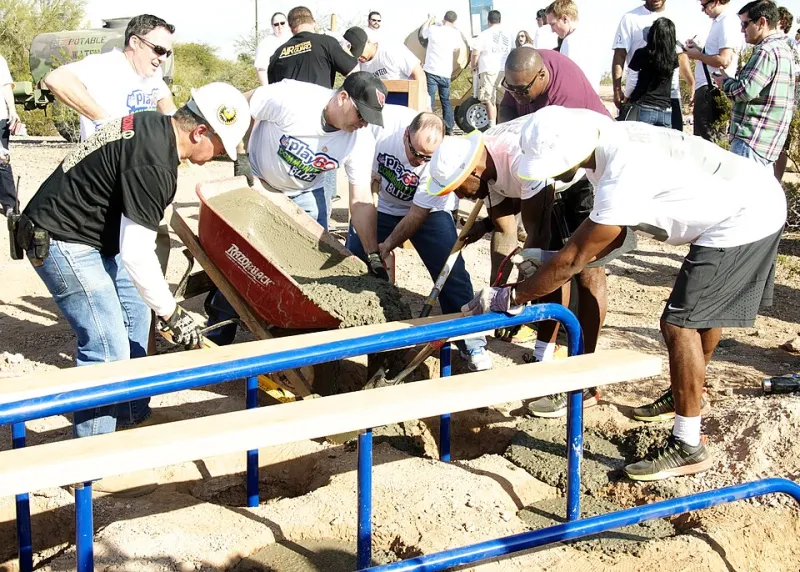
Photo: Sgt. Ryan Scott, Public domain, via Wikimedia Commons
Picture this: it's a Wednesday in October, smack in the middle of a playoff push. Your franchise quarterback is supposed to be in the film room by 8 a.m. Instead, he's on a set in downtown somewhere shooting a fast food commercial that required a 5 a.m. call time, a wardrobe team, a social media crew capturing behind-the-scenes content, and three hours of standing under studio lighting while a director asks for one more take. He makes it to the facility by noon, mentally drained before he's watched a single snap of film.
Nobody talks about this. The league celebrates its most marketable stars, the media amplifies their brand deals, and fans scroll through the Instagram content without ever connecting the dots to what they saw on Sunday — the two fourth-quarter interceptions, the erratic pocket movement, the decision-making that looked nothing like the guy who torched defenses two seasons ago. The connection is real. And it's becoming a serious problem.
The Hidden Schedule Nobody Publishes
An NFL player's official schedule is already brutal. Practice, film, treatment, meetings, more film, more treatment. During the season, the margin for genuine rest and mental recovery is razor-thin. What the official schedule doesn't show is the shadow calendar that elite endorsement deals create.
For a player carrying five or six major brand partnerships — which is not unusual for a top-five quarterback or a household-name receiver — the additional obligations are staggering. Contractual appearance minimums. Social media posting requirements with specific engagement benchmarks. Seasonal campaign shoots timed to product launches. Charity appearances attached to brand activations. Media training sessions. Meetings with marketing agencies. All of it stacked on top of an already demanding professional workload.
Some of this happens in the offseason, sure. But a lot of it doesn't. Brands want their athletes visible during the season, because that's when the eyeballs are there. A shoe campaign that drops during Super Bowl week is worth infinitely more than one that drops in April. So the shoots happen in October. The campaigns run in November. The athlete is expected to show up and perform for the camera on Tuesday and then show up and perform for the franchise on Sunday, and the assumption is that one doesn't affect the other.
That assumption is increasingly hard to defend.
Mental Load Is a Real Thing
Athletes and their representatives don't love talking about this publicly, for obvious reasons — nobody wants to admit that their off-field business is compromising their on-field product. But sports psychologists and performance coaches who work with elite NFL players are much more candid in private conversations. The concept of mental load — the cognitive energy consumed by managing multiple complex responsibilities simultaneously — is well-documented in performance science. And it doesn't care whether the stress is coming from a blitz package or a brand deal negotiation.
Decision fatigue is particularly relevant here. The research on this is consistent: the more decisions a person makes in a given day, the worse the quality of their later decisions becomes. For a quarterback, whose entire job is rapid-fire decision-making under physical duress, arriving at Sunday with a depleted decision-making reservoir is not a minor inconvenience. It's a performance liability. And the guys with the biggest brand portfolios are making more decisions — more context switches, more approval calls, more creative input sessions — than their less-marketed teammates.
There's also the identity fragmentation angle. Maintaining a public persona that's separate from your athletic identity is genuinely exhausting. The version of yourself that sells headphones is not the same version of yourself that needs to be locked in and ruthless at 4 p.m. on Sunday. Switching between those modes constantly, week after week, has a psychological cost that doesn't show up in the box score but absolutely shows up in clutch moments.
The Clutch Moment Problem
Here's where this gets uncomfortable. If you pull the fourth-quarter performance data on the NFL's most heavily endorsed players over the last several seasons and compare it to their counterparts with smaller brand footprints, the pattern is not flattering for the celebrities. This isn't a hard rule — there are exceptions on both ends — but the trend is consistent enough that several analytics departments around the league have quietly flagged it as a variable worth tracking.
The working theory isn't that endorsements make players bad. It's that the cumulative drain of celebrity maintenance — the constant output of energy toward non-football obligations — reduces the reserves available for the highest-pressure moments of the game. When everything is on the line and the margin for error is zero, the guy running on a full tank has an edge. And the guy who spent Tuesday afternoon doing a commercial reshoot might not be running on a full tank.
What Smart Agents Are Starting to Do About It
A small but growing group of player representatives are actually building what they're calling bandwidth audits into their clients' endorsement negotiations. Before signing a new deal, they're mapping out the actual time and energy obligations against the player's existing schedule and flagging anything that creates a conflict during peak season weeks. Some are negotiating blackout periods — windows during the season where the player has zero brand obligations — as a non-negotiable contract term.
This is smart. It's also a sign that the industry is slowly acknowledging something it's been reluctant to admit out loud: the endorsement machine can be extractive, and the people most at risk of getting extracted are the ones with the most to lose on the field.
The Price of the Brand
None of this is an argument against athletes getting paid. These guys have short windows to build generational wealth, and they should absolutely maximize every legitimate opportunity. But there's a version of this conversation that the league, the agencies, and the players themselves need to have more honestly — the one where someone in the room asks whether the seventh endorsement deal is actually worth what it costs.
Not in dollars. In watts. The energy it drains. The focus it pulls. The Sunday afternoon moments it might be quietly stealing.
The most dangerous thing about this problem is how invisible it is. Nobody sees it happening in real time. They just see a great player having an inexplicably bad game in December, shrug, and move on. The endorsement machine keeps running. The tank keeps draining. And somewhere in a fourth quarter that matters, the lights flicker — and nobody connects it back to the Tuesday morning they should have been in the film room.